
Why is PR crucial in 2026? – Trust, reputation, and the new era of AI

Below, we explain why PR is indispensable in 2026, based on the latest global research.
1. Reputation creates tangible business value
Corporate reputation is not an abstract concept, but a measurable business indicator.
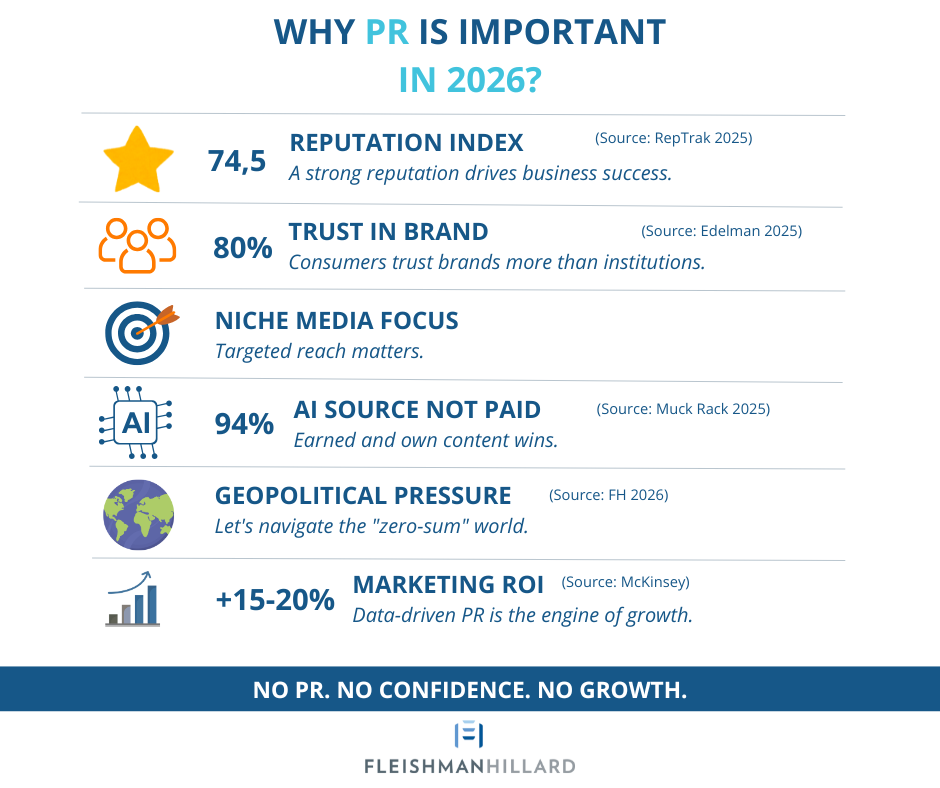
According to RepTrak's 2025 global data, companies' reputation scores continued to strengthen, reaching a global average of 74.5, while reputation-related business behaviors—such as purchase and recommendation intent—improved across all categories.[1]
This means that a good reputation directly increases business results today.
The quality of crisis management is particularly critical. According to a study by Pentland Analytics, which analyzed data from several decades, a reputation crisis can have a negative impact on shareholder value in the long term, while well-managed crises can even lead to outperformance.[2]
2. In an era of crisis of confidence, organic credibility is currency
Consumers' values have changed: they no longer look to institutions for guidance, but to brands.
- According to the Edelman Trust Barometer, 80% of people trust their own brands more than the media, government, or other institutions.[3]
- The Reuters Institute emphasizes that trust in news media is declining in many countries, while consumption is increasingly shifting to social and video platforms.[4]
- Pew Research shows that trust has become highly polarized: consumers judge the same source very differently along political fault lines.[5]
In this environment, earned content—journalistic articles, expert commentary, independent reviews—becomes the brand's most credible communication tool.
3. The media landscape has fragmented – relevant reach matters, not mass reach
According to FleishmanHillard Corporate Affairs Trends 2026, the media landscape is now completely fragmented:
"Everything gets smaller." Audiences are organizing themselves into niches, and the role of traditional, wide-reach channels is steadily declining.[7]
Consumers follow Substack authors, podcasts, professional newsletters, and vertical media—they seek credible information where they can find content that matches their interests.
This sends a clear message to PR: targeted, personalized media relations are more valuable than ever.
4. Artificial intelligence builds on earned content – this is where it is decided what they know about us
The 2025–26 "What Is AI Reading?" study (Muck Rack) analyzed more than 1 million links referenced by AI and came to the following conclusion:
- 94–95% of the sources used by AI models are unpaid,
- ~25% of these are journalistic content,
- and most references are generated in the first 7 days after publication.[7]
In other words:
AI gives us an image that it can build based on our earned and owned content. Those who are not present in authentic content are also left out of AI searches – and thus out of the information space.
5. Under geopolitical pressure, PR becomes the company's "diplomatic capability."
Due to geopolitics, regulatory risks, and zero-sum logic, companies are increasingly forced to control public narratives and build relationships with decision-makers on multiple fronts. According to FH Trends 2026, corporate affairs functions now regularly conduct geopolitical monitoring and reputation and regulatory risk analysis.[7]
The role of PR here is twofold:
- build a stable, consistent corporate narrative,
- maintain a strong network of relationships with public, business, and civil society actors.
6. PR generates direct ROI
According to McKinsey's marketing efficiency research, a well-structured, data-driven communication strategy:
- 15–20% marketing cost savings
- and up to 10% top-line growth with the same budget.[1], [8]
This is crucial in today's cost-conscious environment:
earned communication remains the most effective investment.
Summary: PR in 2026 as a minimum business requirement
PR in today's information space:
- A compass in an environment lacking trust,
- a visibility engine in an AI-driven world,
- a risk management tool in geopolitical uncertainty,
- a growth catalyst by improving marketing efficiency.
In 2026, the question will not be whether PR is necessary, but rather
how quickly an organization can integrate modern, earned-first communication practices.
No PR. No trust. No growth.
Sources
- [1] RepTrak 2025 – Global RepTrak 2025 results
- [2] Pentland Analytics – Reputation Crisis Impact Report
- [3] Edelman Trust Barometer 2025 – Brand Trust Trends
- [4] Reuters Institute Digital News Report 2025 – Media consumption trends
- [5] Pew Research 2025 – Trust in sources and political division
- [6] FleishmanHillard Corporate Affairs Trends 2026 – Everything Gets Smaller, geopolitical trends
- [7] Muck Rack – What Is AI Reading? (2025–26) – AI reference patterns
- [8] McKinsey – Marketing ROI – Efficiency and growth indicators
